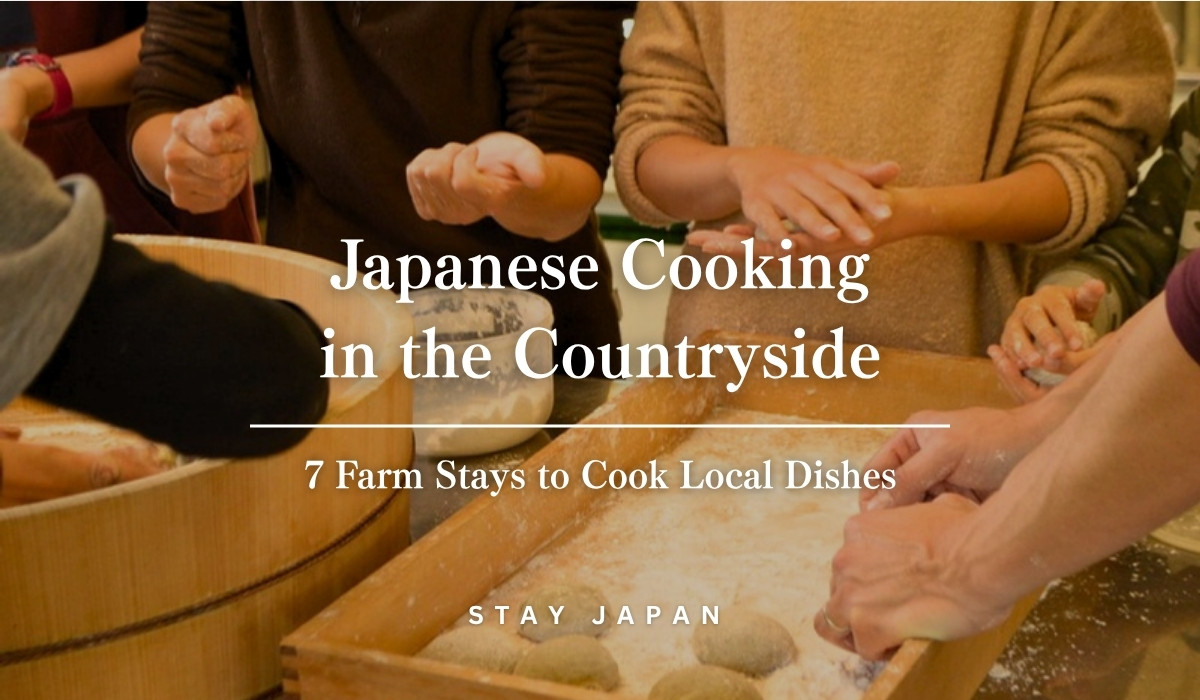

Eating local food on the road is one of the joys of travel. Taking a Japanese cooking class with the people who grew up on that food goes one step further: you start to understand the place itself.
Many of the farm stays and kominka houses on STAY JAPAN invite guests into the kitchen, cooking regional dishes with local ingredients and recipes handed down for generations.
Here are seven stays where you actually make the local food yourself, with your host as your teacher. Think of it as a Japanese cooking class that comes with a bed, a farmhouse table and a taste of everyday rural life.
Why a Japanese Cooking Class at a Farm Stay Stays with You
Just eating it would be a waste. Making it yourself is what turns a meal into a memory.
- A recipe you keep for life
Your host teaches you cooking methods shaped by the local climate and history. Long after the trip, you can still make the dish in your own kitchen. - Right next to where the food is grown
The great advantage of a farm stay is how close you are to the source. Just-picked vegetables and traditional local seasonings give the food a flavour a city restaurant cannot easily match. - The cooking itself becomes the connection
Chopping side by side and asking “How do you cut this?” makes for a warmer kind of travel than sightseeing alone. A Japanese cooking class in someone’s home is as much about the conversation as the food.
7 Farm Stays with a Japanese Cooking Class
1. Farm Inn Ueno House — Tsuruoka, Yamagata
— Cook Ramen & Tsuruoka’s Seasonal Local Dishes Side by Side with Your Host


Tsuruoka is a UNESCO Creative City of Gastronomy, and this farm inn in the Atsumi Onsen area is where you get to cook its food rather than just order it, in what amounts to a Japanese cooking class at the family table. Dinner here is made together: you and the host prepare seasonal local dishes, then sit down to eat them. There is also a ramen-making session where you knead the noodles and make the broth and toppings yourself. Both are booked as add-ons, and the host holds a cook’s licence and a food education instructor qualification.
▶︎ Homestay, up to 6 guests (two Japanese-style rooms, 31 m²)
▶︎ Getting there: About 5 minutes by car from JR Atsumi Onsen Station
▶︎ What you cook: Seasonal local dishes (dinner) and homemade ramen (lunch), both as paid add-ons
2. Farm Inn Bandai — Tokamachi, Niigata
— Make Chimaki and Seasoned Rice with a Professional Cook in Snow Country


Golden fields of Uonuma Koshihikari rice in autumn, deep snow in winter: this is Tokamachi. The host is a professional cook, and you learn to make chimaki (sticky rice wrapped in bamboo leaves) and takikomi gohan (rice cooked with seasonal ingredients). For anyone who loves rice, it is a Japanese cooking class built around the grain itself, and watching the steam rise from a pot cooked the old way is half the pleasure. Seasonal farm work is also on offer, and in winter you can ask about building a kamakura snow hut.
▶︎ Homestay, up to 15 guests (four bedrooms; dinner and breakfast included)
▶︎ Getting there: Pickup from Tokamachi Station (about 10 minutes); 10 minutes on foot from Uonuma-Nakajo Station on the JR Iiyama Line
▶︎ What you cook: Chimaki and takikomi gohan (cooking session is a paid add-on)
3. Magokoro — Iida, Nagano
— Grill Gohei-mochi over an Open Hearth in a Private Kominka


A 150-year-old kominka in the mountains of southern Nagano, rented to one group a day. The signature experience is gohei-mochi: you shape pounded rice onto skewers and grill it slowly over the open hearth until the sweet miso glaze turns fragrant and golden. You can also cook rice in a traditional wood-fired kamado stove (check in by 5pm for this) and skewer river fish for the fire. A chef trained in Japanese cuisine runs the kitchen, so the meals are something to look forward to as well.
▶︎ Whole house, up to 5 guests (250 m²; dinner and breakfast included)
▶︎ Getting there: About 35 minutes by taxi from Nukuta Station on the JR Iida Line
▶︎ What you cook: Gohei-mochi, kamado-cooked rice, skewered river fish
4. Satoyama Guesthouse Couture — Ayabe, Kyoto
— Cook the Day’s Local Produce in a Quiet Corner of Northern Kyoto


Ayabe sits in the green hills of northern Kyoto Prefecture, far from the crowds of the city. At this small guesthouse you can cook with your host using fresh local ingredients picked that day, in a homely shared kitchen that soon feels like a second home. The menu changes with the season and whatever came in that morning, so part of the fun is finding out what you will make. Think of it as a relaxed Japanese cooking class with no fixed syllabus. The area is known for fireflies in early summer and seas of cloud in winter.
▶︎ Private rooms, up to 4 guests (two rooms)
▶︎ Getting there: About 20 minutes from Higashi-Maizuru Station on the JR Maizuru Line; about 40 minutes by public transport from Umesako Station
▶︎ What you cook: Seasonal dishes with local ingredients (co-cooking is charged separately)
5. Japanese-style Room WASITU (Kawanishien) — Takamatsu, Kagawa
— Knead Sanuki Udon by Hand and Foot in “Udon Prefecture”


Kagawa calls itself “Udon Prefecture”, and this friendly farm inn in Takamatsu lets you make the real thing. In the uchikomi udon session, you mix the dough from flour and tread it underfoot to give the noodles their famous chewy bite, then cut them thick and simmer them with seasonal vegetables in a miso-based broth. It is a bowl that warms you right through, and a Japanese cooking class that noodle lovers will remember. A breakfast plan made with local vegetables can be added too, and two cats live in the house.
▶︎ Homestay, up to 2 guests
▶︎ Getting there: About 15 minutes by taxi from Takamatsu Airport; about 10 minutes by taxi from Hashioka Station on the JR Yosan Line
▶︎ What you cook: Uchikomi udon (paid add-on)
6. Yuuga-no-Mori — Taragi, Kumamoto
— Soba, Bamboo-Cooked Rice and Home Cooking in the Kuma Countryside


A countryside inn in the Kuma district of Kumamoto with a long list of food experiences. Alongside local home cooking, you can try hand-made soba noodles and takemeshi, rice cooked inside a length of fresh bamboo. You can also harvest vegetables from the field and cook them straight away, the way a farm stay should work. The host is a keen and skilled cook, and dinner is served in the small izakaya she runs next door, with local Kuma shochu to match.
▶︎ Up to 7 guests (dinner and breakfast included)
▶︎ Getting there: About 10 minutes by car from Taragi Station on the Kumagawa Railway; about 20 minutes from Hitoyoshi IC on the Kyushu Expressway
▶︎ What you cook: Local dishes, soba, takemeshi (paid; book at least 3 days ahead, subject to weather and season)
7. Orihime, a Pure Japanese-style Room — Saito, Miyazaki
— Local Cooking and House-Smoked Bacon Near an Old Castle Site


Near the ruins of Tonokori Castle, once the main seat of the Ito clan, stands a characterful kominka whose family brewed shochu until the grandfather’s generation. Here a Japanese cooking class of about two hours has you cook local dishes, using fresh Saito produce seasoned with homemade miso and traditional persimmon vinegar. Groups of three or more on a multi-night stay can also make bacon from local branded pork, cured for a week and smoked for around seven hours. An Omotesenke-school tea ceremony with local sweets is on offer in the tea room as well.
▶︎ Private room, up to 3 guests (the house sleeps up to 8 across three rooms)
▶︎ Getting there: About 45 minutes by taxi from Miyazaki Airport; about 25 minutes by taxi from Sadowara Station on the JR Nippo Line
▶︎ What you cook: Local dishes and homemade bacon (both paid; no restaurants within walking distance, so book meals too)
How to Choose a Japanese Cooking Class Stay
Match the stay to the purpose of your trip and the people you are travelling with, and the day itself will be far more satisfying.
1. Choose by Type of Experience
- From field to table: At stays like Yuuga-no-Mori, you can pick vegetables before you cook them. Ideal if you want to see how local life really works.
- One dish, done properly: Soba, udon or gohei-mochi sessions focus on mastering a single regional dish, and they are great fun for families and groups.
2. Choose by Type of Stay
- Homestay: You share a roof with the host family. Best for anyone who wants to be treated like one of the family.
- Whole-house rental: Just you, your family or your group. Best for cooking and relaxing at your own pace.
💡 A tip before you book
Menus and ingredients can change with the season and what is available on the day. When you book, message your host to ask what kind of Japanese cooking class they can offer on your dates. It makes the day smoother, and gives you something to look forward to.
New to farm stays? Read Japanese Farmhouse Stay: What to Expect on Your First Visit before you go.
Travel to Cook the Local Food
All seven stays above can be booked on STAY JAPAN. Pick a region, pick a dish, and make your next trip one where you cook the local food with your own hands. A Japanese cooking class in a farmhouse kitchen is a souvenir you can take home and make again.
Also worth reading: Rice Farm Stay Japan: 7 Rice Farmers’ Homes to Taste Autumn’s New Rice